The Messiah and Me
By Naomi Sack Vice President Brighton Orpheus Choir & former choir member 02/12/25
I was brought up in a socialist and committed atheist household in Crawley. Saturday mornings were spent with my father selling the Daily Worker in the town centre. Neither church nor church music figured. However, music was an important part of my early life, although singing was more likely to have been protest songs, Pete Seeger or the Internationale.
I first encountered Handel at the age of 14 while learning to play his recorder sonatas. They were not easy but I loved playing them, particularly the one in A minor. I don’t remember when I first heard the Messiah. It seems to have become embedded in my being over many years as I suspect it has for many people. I do have clear memories of the piece when it was performed by the Orpheus choir in 2007, not long after I joined as an alto. We were all energised by the music, not least our musical director and conductor, Stella Hull, who positively ‘danced’ whilst conducting it. I have a particularly happy memory of a Saturday afternoon rehearsal in December when the soloists, orchestra and choir came together for the first time. The rehearsal was so absorbing. It was a lovely experience when all one’s troubles could be left behind.
The first performance of the Messiah was in 1742 in Dublin in aid of a charitable institution. Reputedly composed in three weeks, the work reflects the energy that it must have taken to write. It has been described as triumphant, joyful, invigorating, exuberant, uplifting, awe inspiring, and exhilarating. At times the music skips along as in ‘For unto us a child is born’ and as in ‘his yoke is easy’. At other times it has a majestic solemnity as in ‘He was despised and rejected’.
One of the most moving renditions of any part of the Messiah I have ever heard was Alice Coote singing ‘despised and rejected’ in a bath on stage at the Brighton Dome. Its undercurrent was haunting. She explained in her after-show discussion that she was singing in honour of her brother who suffered deeply from depression and was homeless.
Another moving memory I have was singing with very small choir at a carol service in the church next door to me. There was one professional tenor whose delivery of ‘Comfort ye’ was so astonishing, it immediately silenced the entire congregation including a large number of young children. They were spellbound.
Handel’s humanity shines through the Messiah with the intensity of a manifesto, so much so that it almost transcends the religious story it is telling. His children’s foundation at Coram’s Fields and his promotion of women singers were both notable and lasting products of his social passion. Handel undoubtedly touches the soul of many, which is why it is performed in churches and civic halls up and down the country as we approach Christmas.
A few years ago I found in an Oxfam shop a C19th manuscript of the Messiah. On the back page is an inscription written in copper-plate handwriting, dated 2002. It reads…
‘I found Handel around the age of twelve and I was hooked for ever. The aria “I know that my Redeemer liveth” has got to be the piece de resistance. I first heard this on the radio at around fourteen to fifteen years old and thought it exquisite, especially when sung by the great, late, Isobel Bailey. It still touches my soul and I am now 63 past. Thank you George Frederick and bless you. Someone someday who shares my love of Handel will, I trust, appreciate this old score. Perhaps whilst I’m listening to Handel on another shore!! Who knows?’
I certainly share this love of Handel and the everlasting affection in which this glorious piece is held. I hope you feel it too.
14TH August 2025
Handel’s Messiah and The Foundling Hospital
Hilary Brown
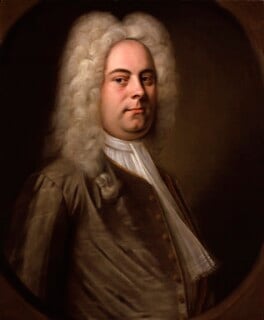 In his early years George Frederick Handel composed Italian operas. These were expensive to stage and profits were slim. As the taste for Italian opera waned Handel began to develop the English oratorio. This enabled him to dispense with expensive stage sets and costumes and concentrate on the orchestra, soloists and choir. However, these works still needed a large venue. The premier of Handel’s Messiah was for charity and held in Dublin in April 1742. The next year, The Messiah received its London premier in The Covent Garden Playhouse. Sadly, theatres were seen as very disreputable places, and it was considered sacrilegious to perform such a sacred work in a theatre. The performances, scheduled for an entire week, were not well received and badly attended.
Meanwhile in London, permission had been given to Thomas Coram to begin building the Foundling Hospital for abandoned babies and children. Once established the Hospital quickly became a fashionable place to visit due to the efforts of artist William Hogarth, who persuaded other successful artists such as Joshua Reynolds and Thomas Gainsborough to exhibit their work at the hospital. While at the Foundling Hospital visitors could see the children having their meals and singing in the chapel and would hopefully donate money.
Handel must have recognised the potential of the Foundling Hospital’s Chapel as a good venue and in May 1749 he offered to stage a charitable concert for the foundling children. The concert programme included the first performance of Handel's “Foundling Hospital Anthem”, ending with the Hallelujah Chorus from his Messiah, which would have been unknown to most of his audience.
The concert was extremely successful. Handel donated an organ to the chapel and then returned the next year to perform The Messiah and raise funds for the hospital again. The event was so popular that wealthy supporters had to be turned away on the night and Handel was asked to repeat the concert two weeks later. To show its gratitude, the Foundling Hospital made Handel a Governor.
So, it is possible that without Handel’s association with this charity, The Messiah might have fallen into obscurity. Today Handel's Messiah is Britain's most popular choral work.
While the original Foundling Hospital is gone, its legacy lives on as the Coram group of charities, supporting vulnerable children and families.